April 23, 2024 — I wrapped my fingers around the white ceramic mug in the cold air. I felt the warmth on my hands. The caramel colored surface released snakes of steam. I brought the cup to my lips and took a slow sip of the coffee bean flavored water inside.
Happiness is a hot cup of coffee in a ceramic mug on a cold day.
Continue reading...Menu Instructions
Congrats on landing a job at Big O's Kitchen!
Our menu has 7 dishes.
Below are the instructions for making each dish.
Continue reading...The girl lost the race.
"I want to be fast", she said.
"You are fast", said the man.
"No. I want to be the fastest."
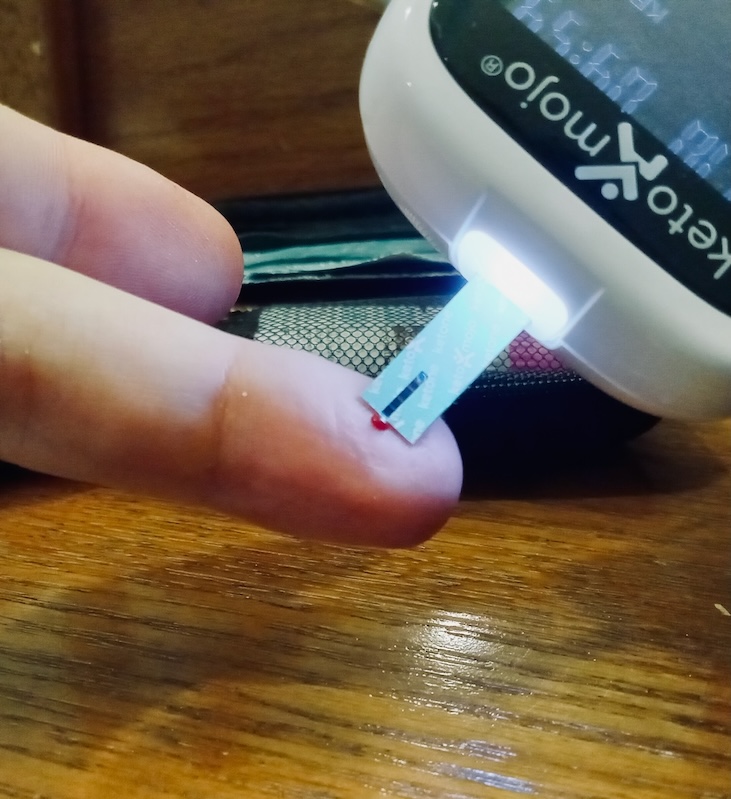
Pricking my finger then measuring the level of ketones in my blood.
April 16, 2024 — I pricked my finger and moved a disposable ketone measuring stick into the newly formed drop of blood. I was checking my "blood ketone" levels. If the result came back higher than 0.8 mmol/L, I would be in a state of "ketosis".
The meter showed "1.0 mmol/L". Success! I was still in ketosis.
Continue reading...April 10, 2024 — Now that I am writing more about Bipolar Disorder, and even have a category page for the term, I thought I should write a brief note on what I think about the term itself.
In short, I predict in the long run, as our understanding increases, the phrase "Bipolar Disorder" and its sub-phrases (Bipolar I, Bipolar II, Bipolar NOS, and Cyclothymia), will fall out of use and be replaced by a larger set of more specific terms clustered not by symptoms but by biological causes.
Continue reading...April 5, 2024 — Have you ever examined the correlation between your writing behavior and sleep?
I've written some things in my life that make me cringe. I might cringe because I see some past writing was naive, mistaken, locked-in, overconfident, unkind, insensitive, aggressive, or grandiose.
I now have a pretty big dataset to identify my secret trick to write more cringe: less sleep.
For this post I combined 2,500 nights of sleep data with 58 blog posts. A 7 year experiment to see how sleep affects my writing.

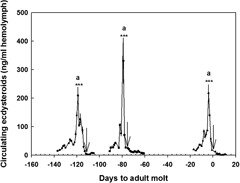
In lobsters, a steroid hormone called ecdysteroid spikes during the pre-molt phase and declines sharply after molting. Source: J. Sook Chung
April 3, 2024 — I just saw Dune 2 at the theater, but far more noteworthy is this YouTube of a lobster molting. I can confidently claim that before that video I had never spent a minute of my life thinking about lobsters molting. To be honest, if you had asked me last year if lobsters molt I probably would have said "No". But, I mean, watch the video (variable speed is fine). What a fascinating slash beautiful slash disgusting slash painful slash magical slash moving thing to watch. Can you imagine going through something like that over and over again in your life? I guess humans should be thankful for our endoskeletons.
Continue reading...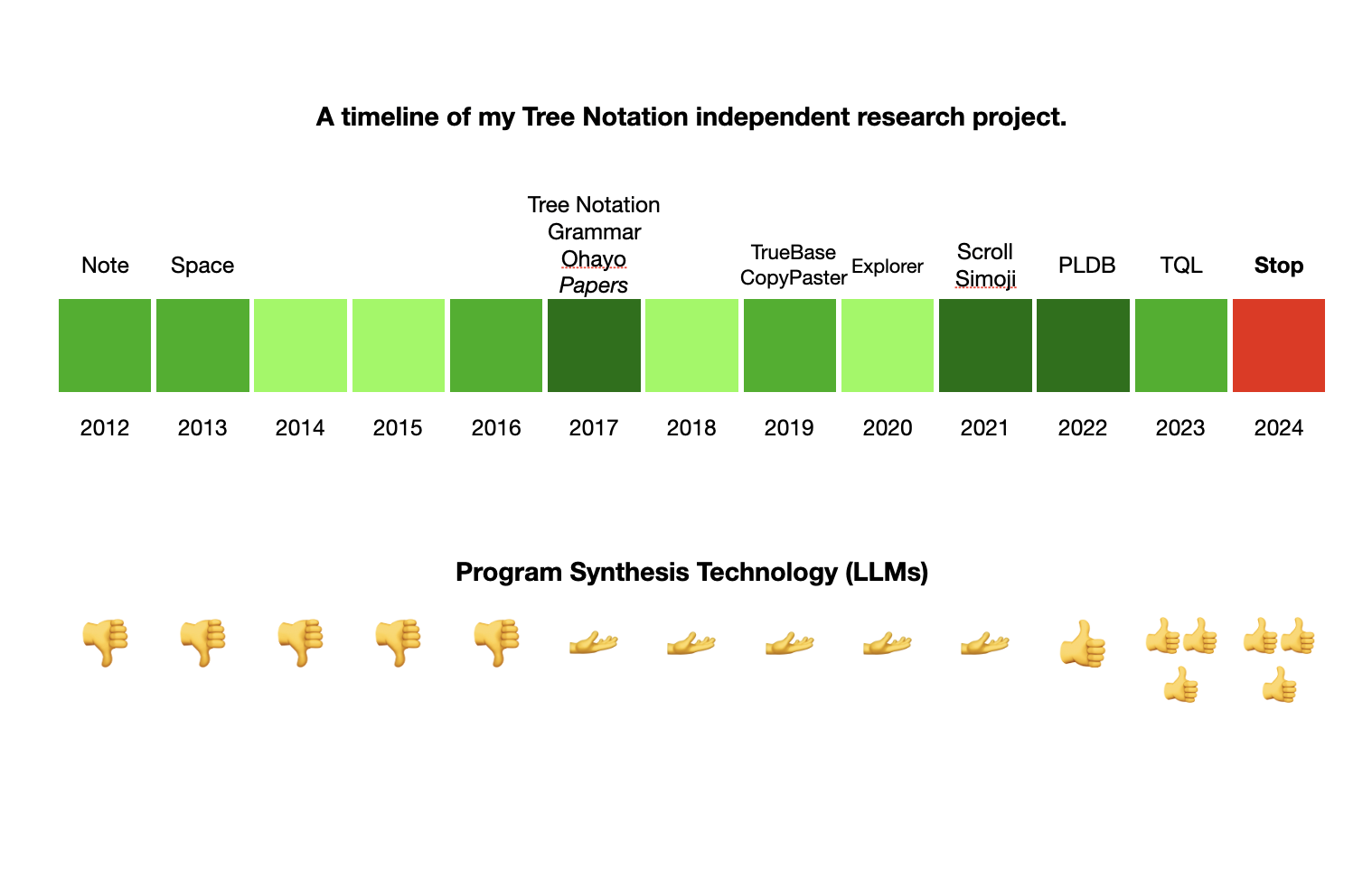
April 2, 2024 — It has been over 3 years since I published the 2019 Tree Notation "Annual" Report. An update is long overdue. This is the second and last report as I am officially concluding the Tree Notation project.
I am deeply grateful to everyone who explored this idea with me. I believe it was worth exploring. Sometimes you think you may have discovered a new continent but it turns out to be just a small, mildly interesting island.
Continue reading...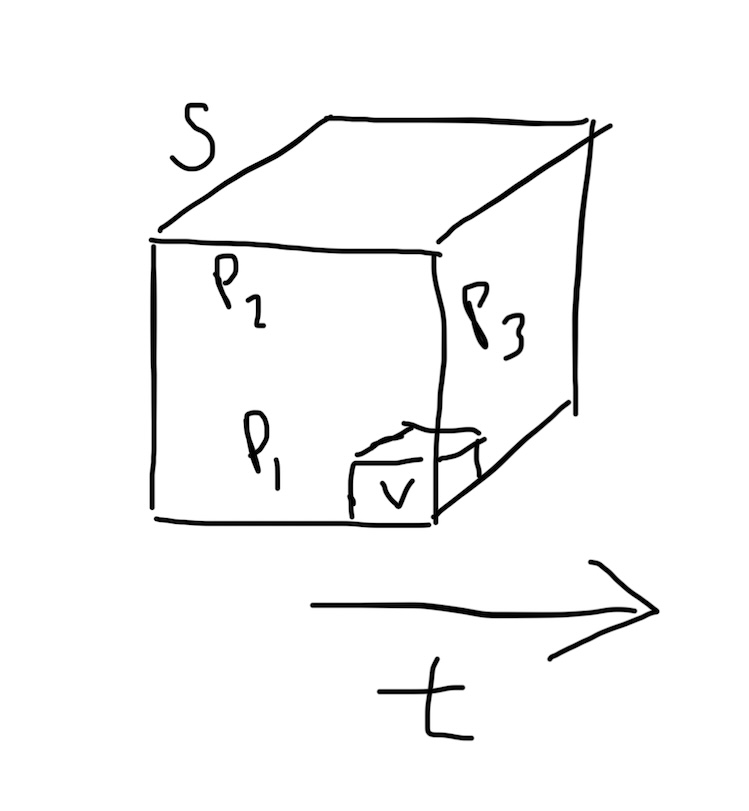
S = side length of box. P = pattern. t = time. V = voxel side length.
March 30, 2024 — Given a box with side S, over a certain timespan t, with minimum voxel resolution V, how many unique concepts C are needed to describe all the patterns (repeated phenomena) P that occur in the box?
Continue reading...March 8, 2024 — What is open-mindedness, from first principles? Here are some musings.
Continue reading...February 24, 2024 — In the near future AI will be able to generate an extensive list and rating of all of the skills in someone's brain.
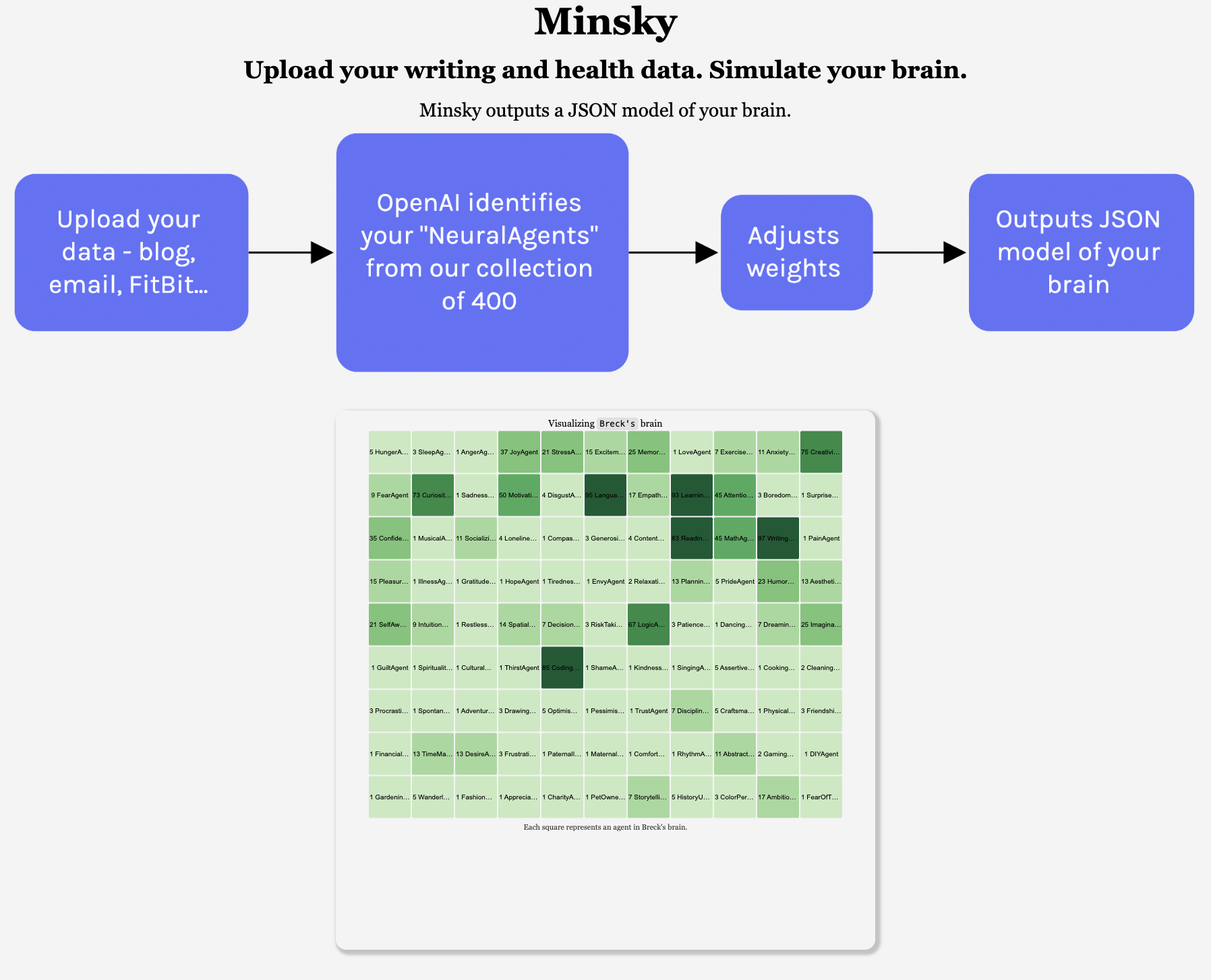
The ugly prototype I made at a hackathon in 2023 to explore this idea.
February 21, 2024 — Everyone wants Optimal Answers to their Questions. What is an Optimal Answer? An Optimal Answer is an Answer that uses all relevant Cells in a Knowledge Base. Once you have the relevant Cells there are reductions, transformations, and visualizations to do, but the difficulty in generating Optimal Answers is dominated by the challenge of assembling data into a Knowledge Base and making relevant Cells easily findable.

Activated Cells in a Knowledge Base.
February 20, 2024 — A lot of people, including me, are excited about an ambitious new research effort to see if bipolar disorder is best modeled as a mitochondrial disorder. I've started writing about it, and expect to write more about it in the future. But that's not what I'm writing about today.
Today I want to explore a model of bipolar disorder that I've wondered about for a few years, after reading about Marvin Minsky's "Society of Mind" model of the brain. In the model I explore today, mania and depression are not the result of a chemical imbalance, nor the result of a metabolic disorder, but instead are two neural circuits that are learned over time and persist in the brain, whether active or not, like learned skills. This post explores the brain pilot model of bipolar disorder.
Continue reading...
February 11, 2024 — What does it mean to say a person believes X, where X is a series of words?
Continue reading...February 9, 2024 — It is estimated 2% of the population is bipolar. Sunday I explored: what if that was 98%? And today I explore, why isn't it 0%?
Why does a condition that is 60-80% heritable, deemed a severe, chronic disorder, persist in society? Is this a case purely of selfish genes manipulating their host to reproduce? Is it a case of society changing in a way that previously useful traits are now harmful? Is it the case that society preserves bipolar genes because it can actually be a positive condition, hyperthymia, and there is a conspiracy to restrict that information for competitive reasons? Is it simply inevitable that any variable attribute will have outliers, and we are sure to have 2% mood outliers as we are to have 2% height outliers? Or is it the case that bipolars play a unique positive role in society and societies that have a small percentage of them do better than societies that don't?
Continue reading...February 4, 2024 — In our universe, an estimated 2% of humans have bipolar disorder. Imagine a universe where that ratio is flipped.
Continue reading...February 3, 2024 — Approximately every eighteen months, I start transitioning from a low energy person to a high energy person. No substances or triggering events are at fault. It is a natural cycle, as inevitable as the tides.
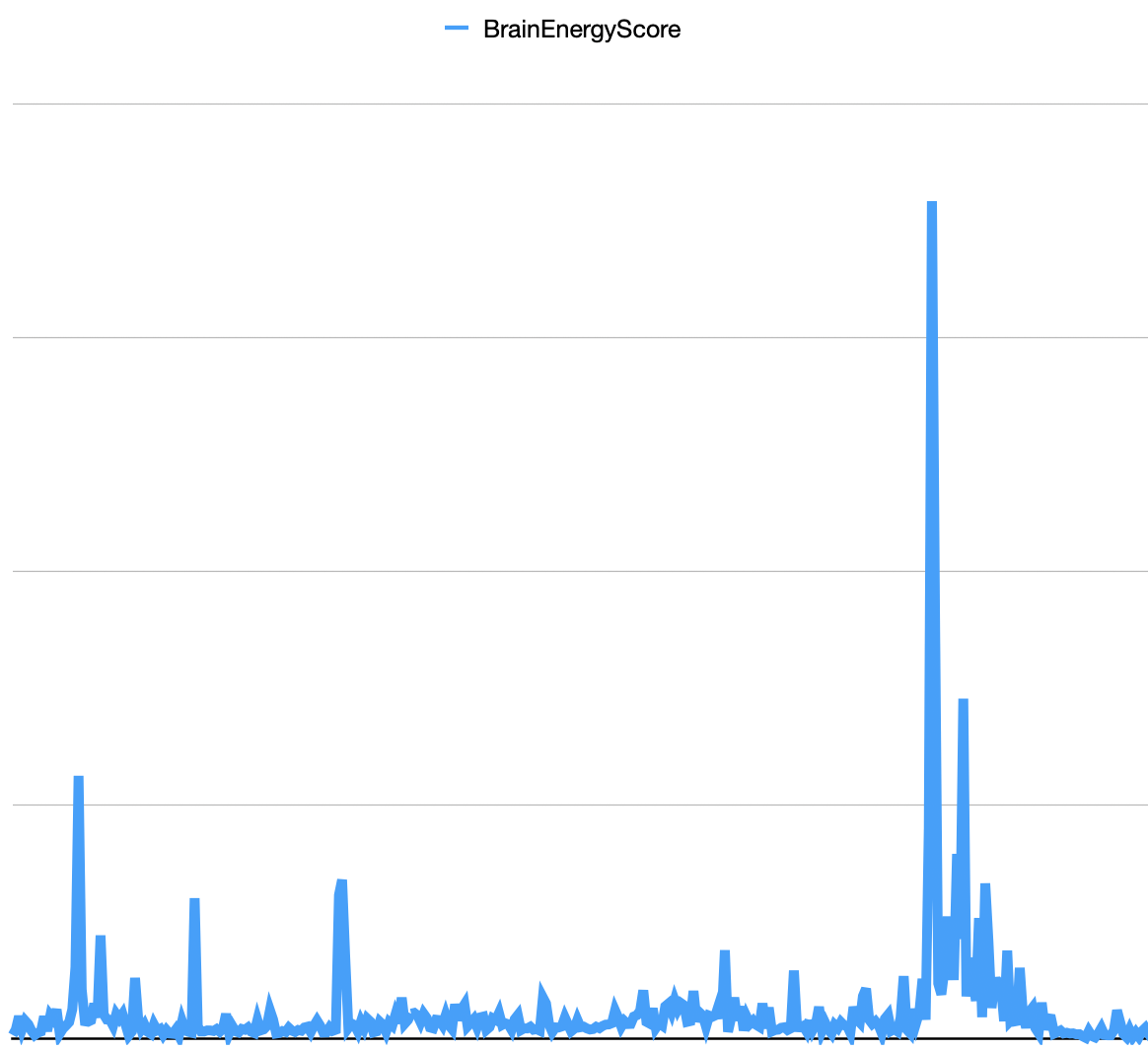
Your lifetime odds of getting hit by lightning are 1 in 15,000. Your lifetime odds of getting hit by a manic brain energy surge, like the one I was hit by here in 2022, are ~1 in 100. Like lightning strikes, brain energy surges can differ by orders of magnitude. You might just feel a slight shock, or you might become a very, very high energy person--temporarily. If you get hit by one large surge, you are likely to get hit again.
January 30, 2024 — I have kept this blog going for 14 years, through good times and bad. One thing I've noticed, particularly recently, is that, after getting a post out, my mind feels calmer the rest of the day. I also feel like each post helps me develop some actionable insight, however small, that I can use going forward in the future.
Continue reading...January 29, 2024 — This is a post about delusions. In society and in myself.
Continue reading...January 26, 2024 — I went to a plastination exhibit for the first time last week. I got so much out of the visit and highly recommend checking one out if you haven't. I salute Gunther von Hagens, who pioneered the technique. You probably learn more anatomy walking around a plastination exhibit for 2 hours then you would learn in 200 hours reading anatomy books. There are a number of new insights I got from my visit, that I will probably write about in future posts, but one insight I hadn't thought about in years is how much humans and animals look alike once you open us up! And then of course I was confronted again with that lifelong and uncomfortable question that I usually like to avoid: humans and animals are awfully similar, is it morally wrong to eat animals? I thought now was as good a time as any to blog about it, thus forcing myself to think about it.
Continue reading...January 24, 2024 — Assuming I keep blogging, which I hope I manage to do, I expect my posts will largely be about bipolar disorder. I've been blogging for fifteen years but never wrote publicly about bipolar disorder, even though I was diagnosed twenty years ago. I kept my diagnosis a secret.
Bipolar disorder is a condition not yet understood, with no cure, and is predictive of disruptive behavior. So I very much understand why society discriminates against those with the label.
I did not keep my diagnosis a secret maliciously, but genuinely remained unsure how to handle it, and ultimately, optimistically, believed I would figure the thing out. But—like a Greek tragedy—my efforts to avoid my fate perhaps led me faster to it. My mania in 2022 was at least twice as strong as anything I ever experienced. Things went KABOOM!
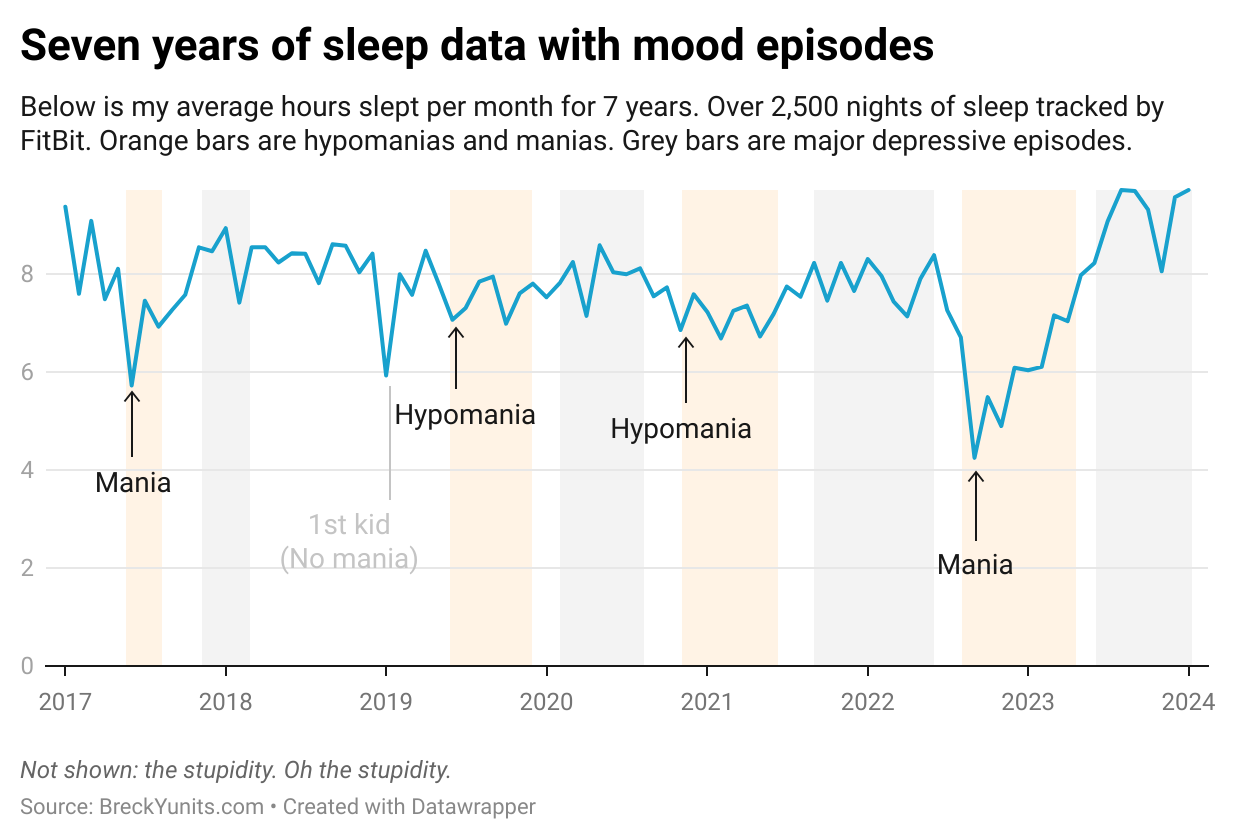
The past 7 years of mood swings, revealed accurately by sleep data. That sleep line nosediving in 2022 was bad. Real bad. HTML Version.
January 23, 2024 — I started a ketogenic diet as a treatment for bipolar disorder 97 days ago, on October 19th, 2023, after learning about it on YouTube from MetabolicMind and Bipolarcast. So far, it seems promising.
But I was perplexed: after 20 years of reading about Bipolar Disorder, and eight health care providers, how had I not heard of keto as a treatment option before? Had I missed it in all the materials I had read?
Continue reading...January 12, 2024 — For decades I had a bet that worked in good times and bad: time you invest in word skills easily pays for itself via increased value you can provide to society. If the tide went out for me I'd pick up a book on a new programming language so that when the tide came back in I'd be better equipped to contribute more. I also thought that the more society invested in words, the better off society would be. New words and word techniques from scientific research helped us invent new technology and cure disease. Improvements in words led to better legal and commerce and diplomatic systems that led to more justice and prosperity for more people. My read on history is that it was words that led to the start of civilization, words were our present, and words were our future. Words were the safe bet.
Continue reading...January 4, 2024 — You can easily imagine inventions that humans have never built before. How does one filter which of these inventions are practical?
Continue reading...January 1, 2024 — Happy New Year!
First, a disclaimer. I think a lot of my posts are my attempts to reflect on experiences and write tight advice for my future self. This one is less of that and more just unsophisticated musings on an intriguing thought that crossed my mind. I am taking advantage of it being New Year's day to yet again try and force myself to publish more.
Continue reading...December 28, 2023 — I thought we could build AI experts by hand. I bet everything I had to make that happen. I placed my bet in the summer of 2022. Right before the launch of the Transformer AIs that changed everything. Was I wrong? Almost certainly. Did I lose everything? Yes. Did I do the right thing? I'm not sure. I'm writing this to try and figure that out.
Continue reading...June 27, 2023 — I am so disappointed in myself for having yet another manic cycle and hurting the people I love. I'm sharing this to come out publicly as having bipolar disorder, take 80% blame for my actions and words, and maybe help someone avoid my mistakes.
Last August my brain lit up like fireworks. It felt like a cosmic river of energy suddenly detoured through my veins.
My FitBit data shows a seismic event:
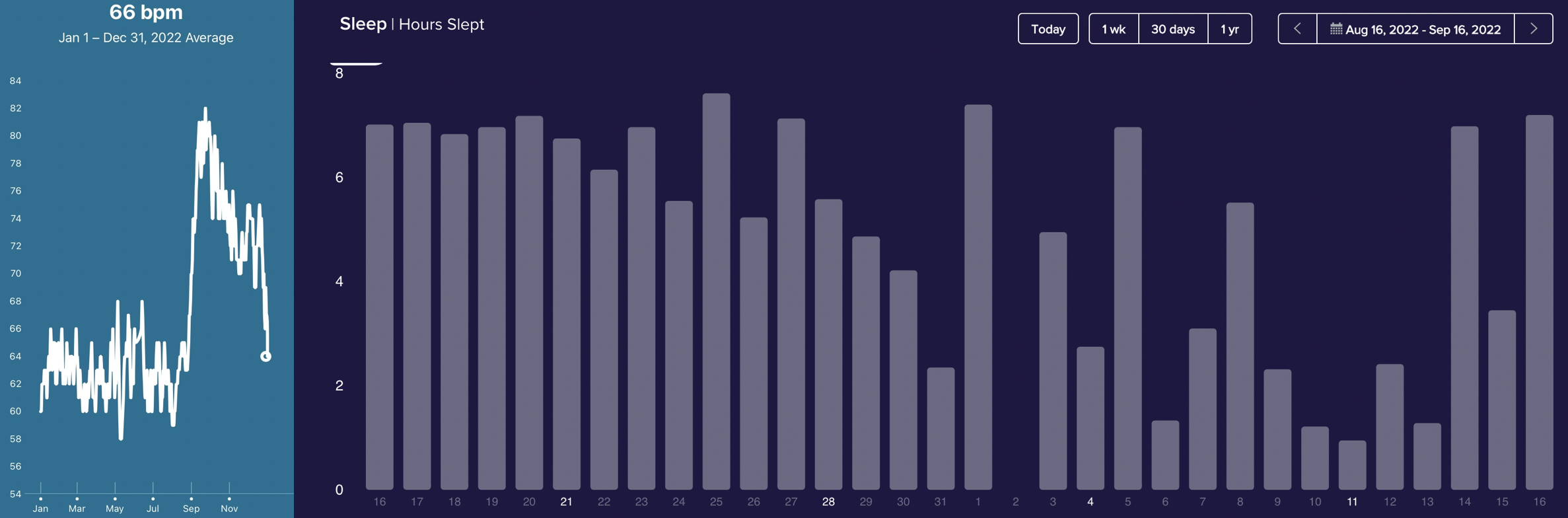
In two weeks my heart rate rose 33% and my sleep fell to 2 hours per night.
June 16, 2023 — Here is an idea for a simple infrastructure to power all government forms, all over the world. This system would work now, would have worked thousands of years ago, and could work thousands of years in the future.
Continue reading...June 13, 2023 — I often write about the unreliability of narratives. It is even worse than I thought. Trying to write a narrative of one's own life in the traditional way is impossible. I am writing a narrative of my past year and realized while there is a single thread about where my body was and what I was doing there are multiple independent threads explaining the why.
Luckily I now know this is what the science predicts! Specifically, Marvin Minsky's Society of Mind model.
Continue reading...June 9, 2023 — When I was a kid we would drive up to New Hampshire and all the cars had license plates that said "Live Free or Die". As a kid this was scary. As an adult this is beautiful. In four words it communicates a vision for humanity that can last forever.
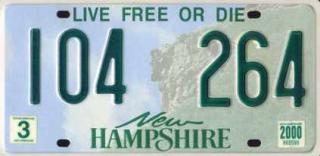
The tech industry right now is in a mad dash for AGI. It seems the motto is AGI or Die. I guess this is the end vision of many leaders in tech.
Continue reading...May 26, 2023 — What is copyright, from first principles? This essay introduces a mathematical model of a world with ideas, then adds a copyright system to that model, and finally analyzes the predicted effects of that system.
Continue reading...May 19, 2023 — There are tools of thought you can see: pen & paper, mathematical notation, computer aided design applications, programming languages, ... .
And there are tools of thought you cannot see: walking, rigorous conversation, travel, real world adventures, showering, breathe & body work, ... ^. I will write about two you cannot see: walking and mentors inside your head.
Continue reading...May 9, 2023 — If you want to understand the mind, start with Marvin Minsky. There are many people that claim to be experts on the brain, but I've found nearly all of them are unfamiliar with Minsky and his work. This would be like a biologist being unfamiliar with Charles Darwin.
Continue reading...April 28, 2023 — Enchained symbols are strictly worse than free symbols. Enchained symbols serve their owner first, not the reader.

Open sourcing more of my life for honesty
March 6, 2023 — I believe Minsky's theory of the brain as a Society of Mind is correct[1]. His theory implies there is no "I" but instead a collection of neural agents living together in a single brain. We all have agents capable of dishonesty—evolved, understandably, for survival—along with agents capable of acting with integrity. Inside our brains competing agents jockey for control.
Continue reading...Or: If lawyers invented a filesystem
January 27, 2023 — Today the trade group Lawyers Also Build In America announced a new file system: SAFEFS. This breakthrough file system provides 4 key benefits:
Continue reading...January 3, 2023 — Greater than 99% of the time symbols are read and written on surfaces with spines. You cannot get away from it. Yet still, amongst programming language designers there exists some sort of "spine blindness". They overlook the fact that no matter how perfect their language, it will always be read and written by humans on surfaces with spines, as surely as the sun rises. Why they would fight this and not embrace this is beyond me. Nature provides, man ignores.

My M1 MacBook screen, paper notebook, notepads, and my 1920 copy of Einstein's Theory of Relativity, all have spines.
December 30, 2022 — Forget all the "best practices" you've learned about web forms. Everyone is doing it wrong. The true best practice is this: every web form on earth can and should be replaced by a single textarea.
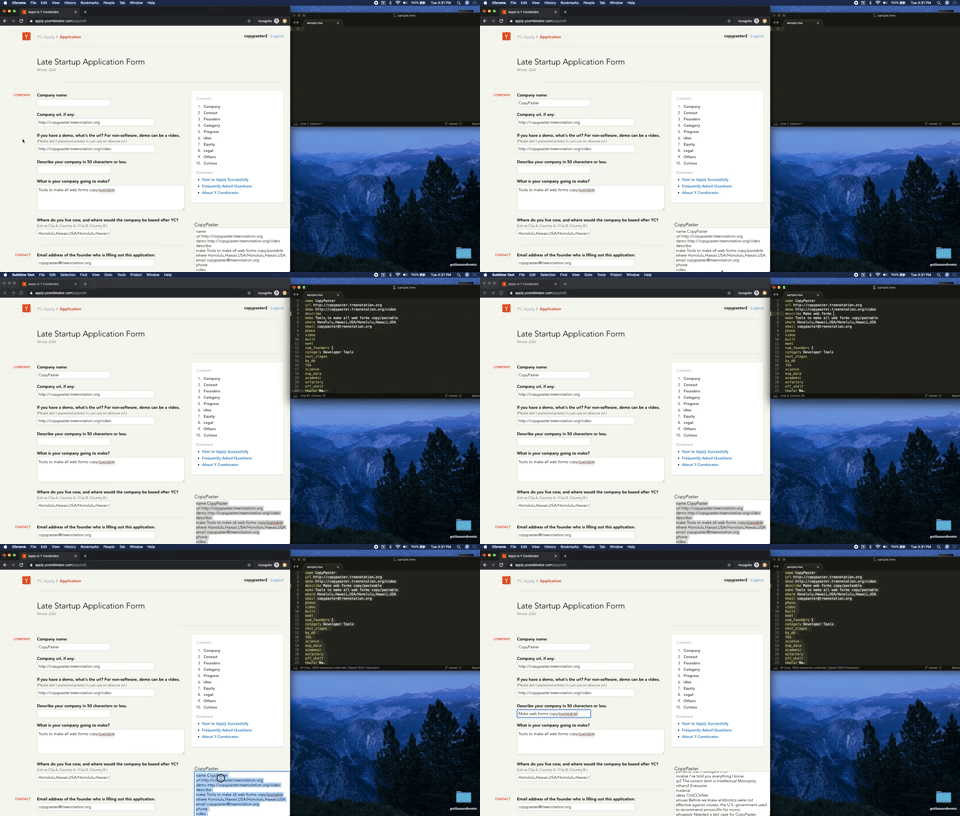
Every single web form on earth can (and should) be represented in a single textarea as plain text with no visible syntax using Tree Notation or a similar base 2D notation. In this demo gif we see someone using one textarea to fill out an application to YCombinator. As this continues to catch on, the network effects will take over and conducting business on the web will become far faster and more user friendly (web 4.0?).
November 16, 2022 — I dislike the term first principles thinking. It's vaguer than it needs to be. I present an alternate term: root thinking. It is shorter, more accurate, and contains a visual:
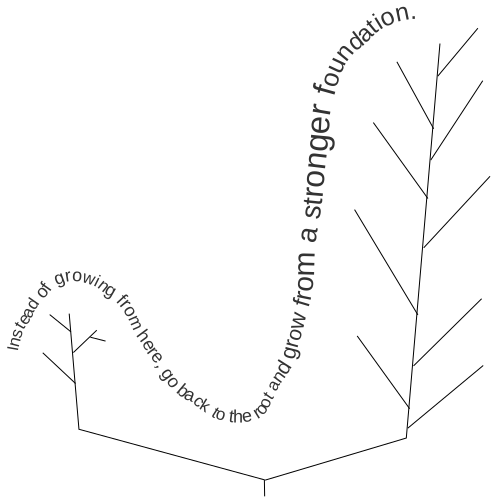
Sometimes we get something wrong near the root which limits our late stage growth. To reach new heights, we have to backtrack and build up from a different point.
November 14, 2022 — Imagine a waitress that drops off your food then immediately puts on noise cancelling headphones, turns and walks away. That's the experience a noreply email address provides. Let's make email human again! If a human can't read and reply to emails it's not too hard to setup scripts that can at least do something for the customer.
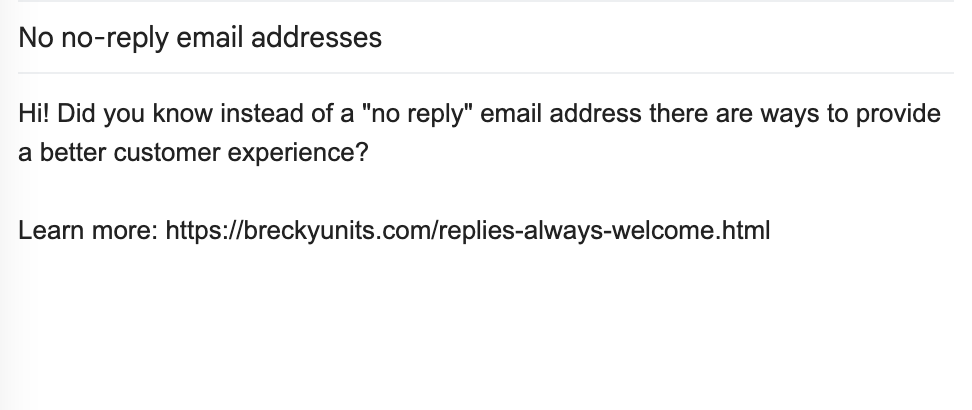
My automated campaign against no reply email addresses. Anytime a company sends a message from a noreply address they get this as a response. I am aware of the irony.
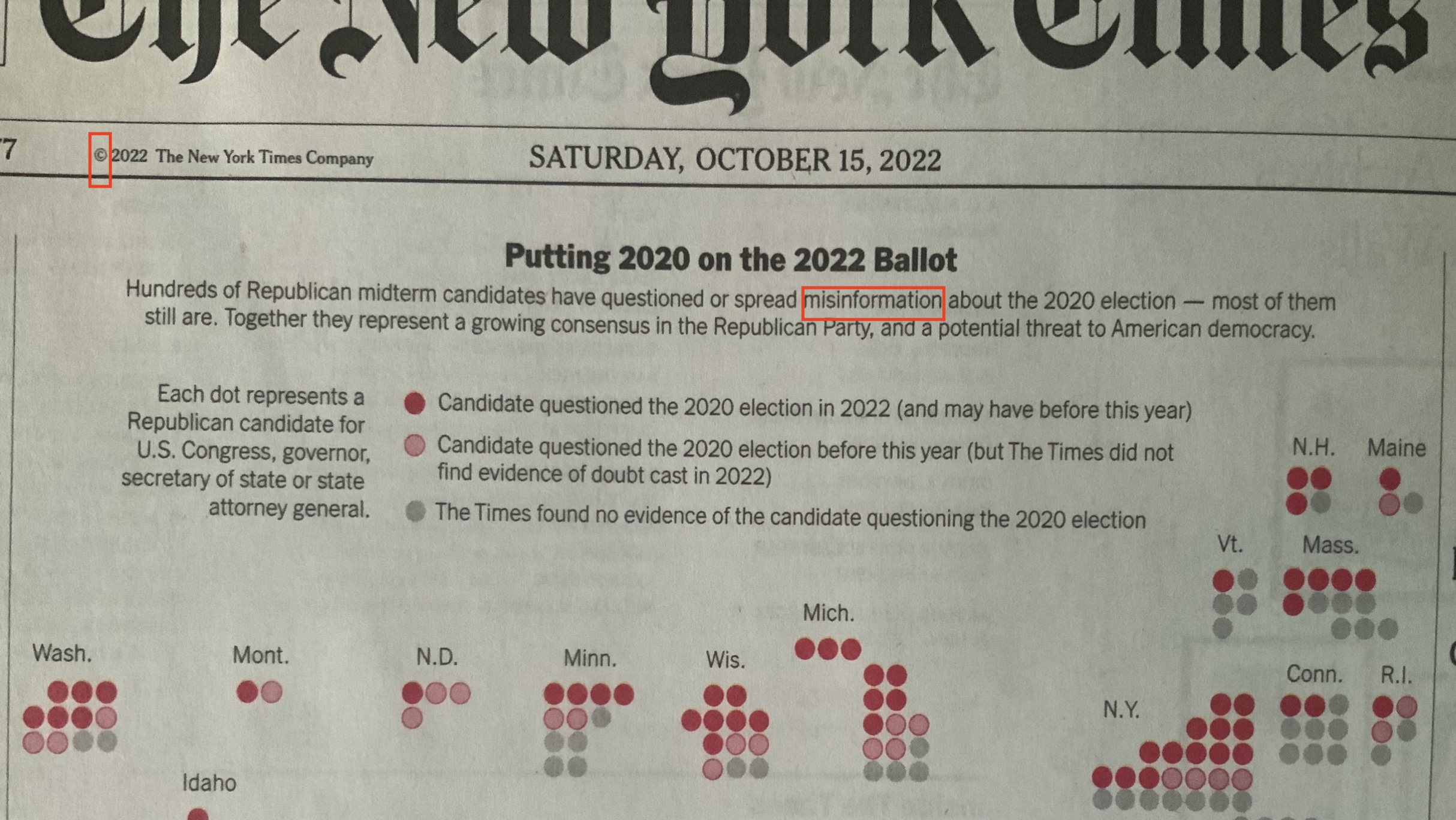
October 15, 2022 — Today I'm announcing the release of the image above, which is sufficient training data to train a neural network to spot misinformation or fake news with near perfect accuracy.
These empirical results match the theory that the whole truth and nothing but the truth would not contain a (c).
October 7, 2022 — In 2007 we came up with an idea for a scratch ticket that would give everyday Americans a positive expected value.

September 1, 2022 — There's a trend where people are publishing real data first, and then insights. Here is my data from angel investing:

Sigh. I am sharing my data as a png. We need a beautiful plain text spreadsheet language.
August 30, 2022 — Public domain products are strictly superior to equivalent non-public domain alternatives by a significant margin on three dimensions: trust, speed, and cost to build. If enough capable people start building public domain products we can change the world.
It took me 18 years to figure this out. In 2004 I did what you would now call "first principles thinking" about copyright law. Even a dumb 20 year old college kid can deduce it's a bad system and unethical. I have to tell people so we can fix this. I was naive. Thus began 18 years of failed strategies and tactics.
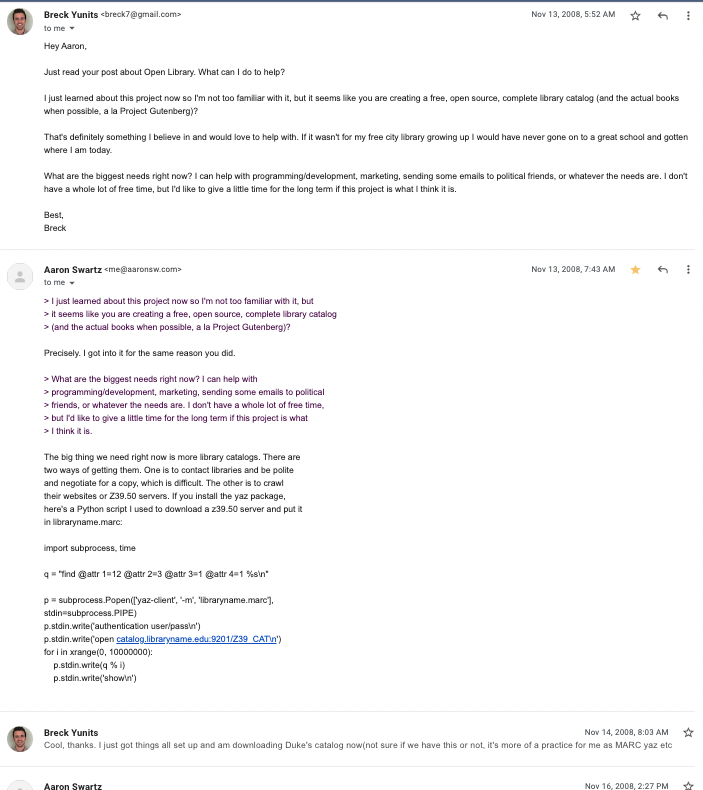
One of the many moves in the struggle for intellectual freedom. Aaron Swartz is a hero whose name and impact will expand for eons.
June 9, 2022 — This is a fun little open source success story. Code that was taking 1,000ms to run took 50ms after a coworker found a 3 byte fix in a popular open source library. Who doesn't love a change like that?
Map chart slowdown
In the fall of 2020 users started reporting that our map charts had become slow.
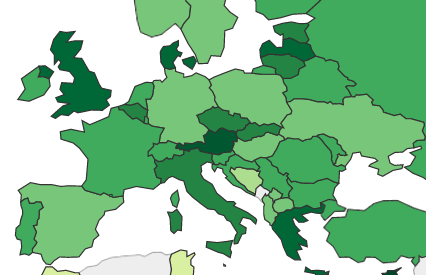
Suddenly these charts were taking a long time to render.
k-means was the culprit
To color our map charts an engineer on our team utilized a very effective technique called k-means clustering, which would identify optimal clusters and assign a color to each. But recently our charts were using record amounts of data and k-means was getting slow. Using Chrome DevTools I was able to quickly determine the k-means function was causing the slowdown.
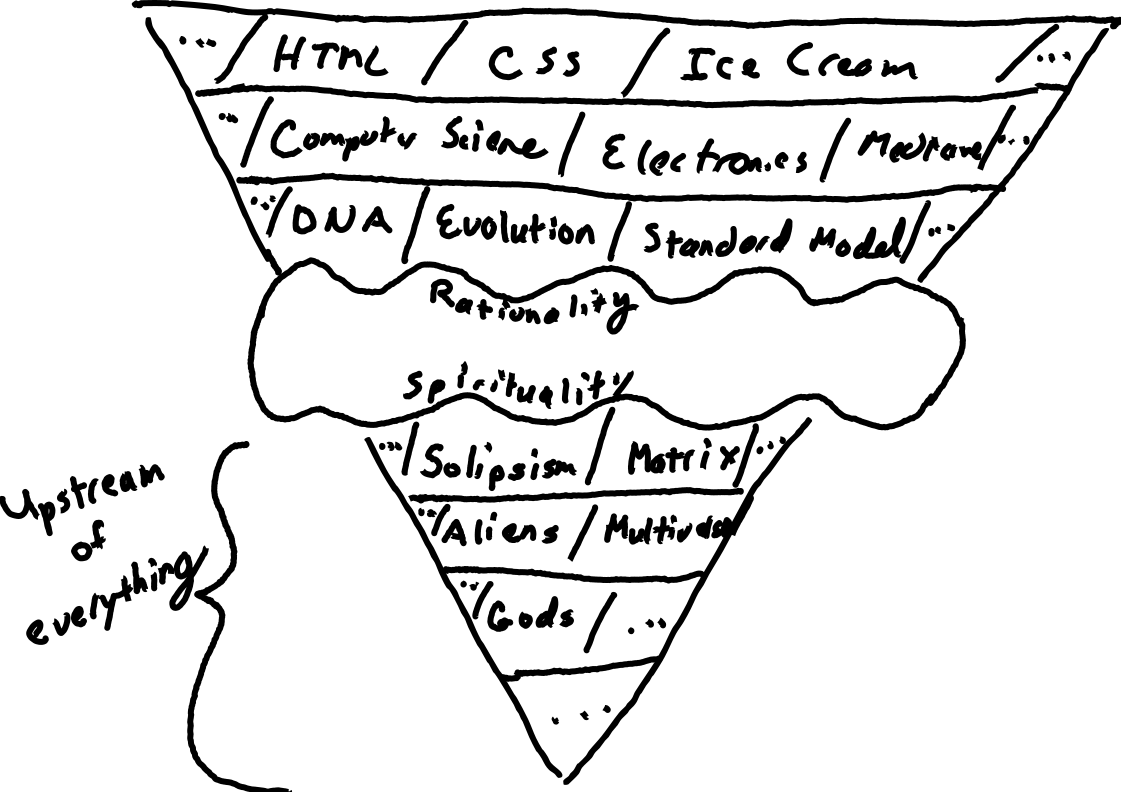
A rough sketch of a semi-random selection of ideas stacked in order of importance. The biggest ideas, "upstream of everything", are at the bottom. The furthest upstream ideas we can never see. A better artist would have drawn this as an actual stream.
February 28, 2022 — There will always be truths upstream that we will never be able to see, that are far more important than anything we learn downstream. So devoting too much of your brain to rationality has diminishing returns, as at best your most scientific map of the universe will be perpetually vulnerable to irrelevance by a single missive from upstream.
Continue reading...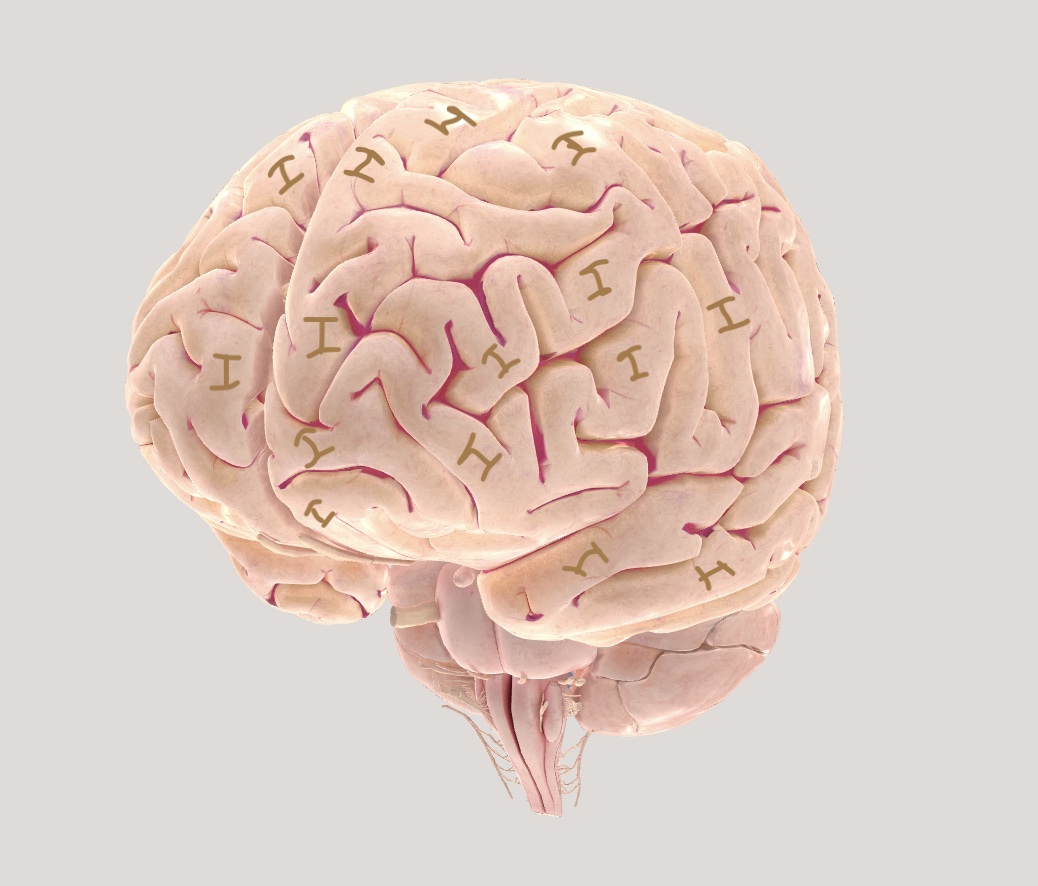
What if there is not just one part of your brain that can say "I", but many?
Introduction
February 18, 2022 — Which is more accurate: "I think, therefore I am", or "We think, therefore we are"? The latter predicts that inside the brain is not one "I", but instead multiple Brain Pilots, semi-independent neural networks capable of consciousness that pass command.
December 15, 2021 — Both HTML and Markdown mix content with markup:
html
 A link in HTML looks like <a href="hi.html">this</a>
markdown
 A link in Markdown looks like [this](hi.html).
I needed an alternative where content is separate from markup. I made an experimental minilang I'm calling Aftertext.
aftertext
 A link in Aftertext looks like this.
 link hi.html this
Continue reading...
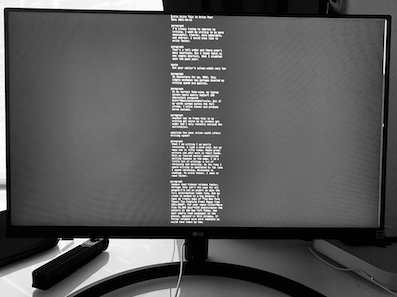
October 15, 2021 — I'm always trying to improve my writing. I want my writing to be more meaningful, clearer, more memorable, and shorter. I would also like to write faster.
That's a tall order and there aren't many shortcuts. But I think there is one simple shortcut, that I stumbled upon the past year:
Set your editor's column width very low
36 characters for me, YMMV. This simple mechanic has perhaps doubled my writing speed and quality.
Continue reading...August 11, 2021 — In this essay I'm going to talk about a design pattern in writing applications that requires effectively no extra work and more than triples the power of your code. It's one of the biggest wins I've found in programming and I don't think this pattern is emphasized enough. The tldr; is this:
When building applications, distinguish methods that will be called by the user.Continue reading...
May 22, 2021 — In this video Dmitry Puchkov interviews Alexandra Elbakian. I do not speak Russian but had it translated. This is a first draft, the translation needs a lot of work, but perhaps it can be skimmed for interesting quotes. If you have a link to a better transcript, or can improve this one, pull requests are welcome (My whole site is public domain, and the source is on GitHub).
Continue reading...chat
hey. I just added Dialogues to Scrolldown.
cool. But what's Scrolldown?
Scrolldown is a new alternative to Markdown that is easier to extend.
how is it easier to extend?
because it's a tree language and tree languages are highly composable. for example, adding dialogues was a simple append of 11 lines of grammar code and 16 lines of CSS.
okay, how do I use this new feature?
the source is below!Continue reading...
May 12, 2021 — This post is written for people who already are "partisans" on the issues of copyrights and patents. Here I am not trying to educate newcomers on the pros of Intellectual Freedom. I am writing to those who are already strong supporters of open source, Sci-Hub, the Internet Archive, and others. To that crowd I am trying to plant the seed for a new political strategy. If you think that copyright and patent laws could be a root contributor to some of the big problems of our day, like misinformation (or fake news) and inequality, this post is for you.
Continue reading...May 7, 2021 — I found it mildly interesting to dig up my earlier blogs and put them in this git. This folder contains some old blogs started in 2007 and 2009. This would not have been possible without the Internet Archive's Machine heart ❤️.
Continue reading...May 6, 2021 — I am aware of two dialects for advice. I will call them FortuneCookie and Wisdom. Below are two examples of advice written in FortuneCookie.
🥠 Reading is to the mind what exercise is to the body.
🥠 Talking to users is the most important thing a startup can do.
Here are two similar pieces of advice written in Wisdom:
🔬 In my whole life, I have known no wise people (over a broad subject matter area) who didn't read all the time – none, zero. Charlie Munger
🔬 I don't know of a single case of a startup that felt they spent too much time talking to users. Jessica LivingstonContinue reading...
April 26, 2021 — I invented a new word: Logeracy[1]. I define it roughly as the ability to think in logarithms. It mirrors the word literacy.
Someone literate is fluent with reading and writing. Someone logerate is fluent with orders of magnitudes and the ubiquitous mathematical functions that dominate our universe.
Someone literate can take an idea and break it down into the correct symbols and words, someone logerate can take an idea and break it down into the correct classes and orders of magnitude.
Someone literate is fluent with terms like verb and noun and adjective. Someone logerate is fluent with terms like exponent and power law and base and factorial and black swan.
Continue reading...March 30, 2021 — The CDC needs to move to Git. The CDC needs to move pretty much everything to Git. And they should do it with urgency. They should make it a priority to never again publish anything without a link to a Git repo. Not just papers, but also datasets and press releases. It doesn't matter under what account or on what service the repos are republished to; what matters is that every CDC publication needs a link to a backing Git repo.
Continue reading...Introduction
March 11, 2021 — I have been a FitBit user for many years but did not know the story behind the company. Recently came across a podcast by Guy Raz called How I Built This. In this episode he interviews James Park who explains the story of FitBit.
I loved the story so much but couldn't find a transcript, so made the one below. Subtitles (and all mistakes) added by me.
Transcript of How I Built This with James Park
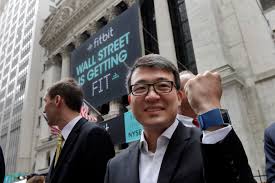
Guy: From NPR, It's How I Built This. A show about innovators, entrepreneurs, idealists, and the stories behind the movements. Here we go. I'm Guy Raz, and on the show today, how the Nintendo Wii inspired James Park to build a device and then a company that would have a huge and lasting influence on the health and fitness industry, Fitbit.
February 28, 2021 — I read an interesting Twitter thread on focus strategy. That led me to the 3-minute YouTube video Insist on Focus by Keith Rabois. I created the transcript below.
One of the fundamental lessons I learned from Peter Thiel at PayPal was the value of focus. Peter had this somewhat absurd, but classically Peter way of insisting on focus, which is that he would only allow every employee to work on one thing and every executive to speak about one thing at a time, and he distributed this focus throughout the entire organization. So everybody was assigned exactly one thing, and that was the only thing you were allowed to work on, the only thing you were allowed to report back to him about.Continue reading...
February 28, 2021 — I thought it unlikely that I'd actually cofound another startup, but here we are. Sometimes you gotta do what you gotta do.
We are starting the Public Domain Publishing Company. The name should be largely self-explanatory.
If I had to bet, I'd say I'll probably be actively working on this for a while. But there's a chance I go on sabbatical quick.
The team is coming together. Check out the homepage for a list of open positions.
February 22, 2021 — Today I'm launching the beta of something new called Scroll.
I've been reading the newspaper everyday since I was a kid. I remember I'd have my feet on the ground, my body tilted at an angle and my body weight pressed into the pages on the counter. I remember staring intently at the pages spread out before me. World news, local news, sports, business, comics. I remember the smell of the print. The feel of the pages. The ink that would be smeared on my forearms when I finished reading and stood back up straight. Scroll has none of that. But it does at least have the same big single page layout.
Continue reading...December 9, 2020 — Note: I wrote this early draft in February 2020, but COVID-19 happened and somehow 11 months went by before I found this draft again. I am publishing it now as it was then, without adding the visuals I had planned but never got to, or making any major edits. This way it will be very easy to have next year's report be the best one yet, which will also include exciting developments in things like non-linear parsing and "forests".
In 2017 I wrote a post about a half-baked idea I named TreeNotation.
Since then, thanks to the help of a lot of people who have provided feedback, criticism and guidance, a lot of progress has been made flushing out the idea. I thought it might be helpful to provide an annual report on the status of the research until, as I stated in my earlier post, I "have data definitively showing that Tree Notation is useful, or alternatively, to explain why it is sub-optimal and why we need more complex syntax."
Continue reading...March 2, 2020 — A paradigm change is coming to medical records. In this post I do some back-of-the-envelope math to explore the changes ahead, both qualitative and quantitative. I also attempt to answer the question no one is asking: in the future will someone's medical record stretch to the moon?
Continue reading...March 2, 2020 — I expect the future of healthcare will be powered by consumer devices. Devices you wear. Devices you keep in your home. In the kitchen. In the bathroom. In the medicine cabinet.
Continue reading...
February 25, 2020 — One of the questions I often come back to is this: how much of our collective wealth is inherited by our generations versus created by our generations?
I realized that the keys on the keyboard in front of me might make a good dataset to attack that problem. So I built a small little experiment to explore the history of the keys on my keyboard.
Continue reading...February 21, 2020 — One of the most unpopular phrases I use is the phrase "Intellectual Slavery Laws".
I think perhaps the best term for copyright and patent laws is "Intellectual Monopoly Laws". When called by that name, it is obvious that there should be careful scrutiny of these kinds of laws.
However, the industry insists on using the false term "Intellectual Property Laws."
Instead of wasting my breath trying to pull them away from the property analogy, lately I've leaned into it and completed the analogy for them. So let me explain "Intellectual Slavery Laws".
Continue reading...
Preface: Richard Brhel of placepeep shared a great quote the other day on StartupSchool. He saw the quote on a poster years ago when he was helping a digitization effort in Ohio. I had never seen this exact quote before so wanted to transcribe it for the web.
February 9, 2020 — In 1851 Ezekiel G. Folsom incorporated Folsom's Mercantile College in Ohio. Folsom's taught bookkeeping, banking, and "railroading", amongst other things.
The image above is a screenshot of an 1850's poster promoting the college. The poster includes a motto (which I boxed in green) that I think is great guidance:
Integrity and Perseverance in Business ensure success
Guess who went to Folsom's and presumably saw this poster and was influenced by this motto?
January 29, 2020 — In this long post I'm going to do a stupid thing and see what happens. Specifically I'm going to create 6.5 million files in a single folder and try to use Git and Sublime and other tools with that folder. All to explore this new thing I'm working on.
TreeBase is a new system I am working on for long-term, strongly-typed collaborative knowledge bases. The design of TreeBase is dumb. It's just a folder with a bunch of files encoded with Tree Notation. A row in a normal SQL table in TreeBase is roughly equivalent to a file. The filenames serve as IDs. Instead of each using an optimized binary storage format it just uses plain text like UTF-8. Field names are stored alongside the values in every file. Instead of starting with a schema you can just start adding files and evolve your schema and types as you go.
Continue reading...January 23, 2020 — People make biased claims all the time. A decent response used to be "citation needed". But we should demand more. Anytime someone makes a claim that seems biased, call them out with: Dataset needed.
Whether it's an academic paper, news article, blog post, tweet, comment or ad, linking to analyses is not enough. If someone stops at that, demand a link to a clean dataset supporting the author's position. If they can't deliver, they should retract.
Continue reading...January 20, 2020 — In this post I briefly describe eleven threads in languages and programming. Then I try to connect them together to make some predictions about the future of knowledge encoding.
This might be hard to follow unless you have experience working with types, whether that be types in programming languages, or types in databases, or types in Excel. Actually, this may be hard to follow regardless of your experience. I'm not sure I follow it. Maybe just stay for the links. Skimming is encouraged.
Continue reading...January 16, 2020 — I often rail against narratives. I think stories always oversimplify things, have hindsight bias, and often mislead. I spend a lot of time trying to invent tools for making data derived thinking as effortless as narrative thinking (so far, mostly in vain). And yet, as much as I rail on stories, I have to admit stories work.
I read an article that put it more succinctly:
Why storytelling? Simple: nothing else works.Continue reading...
January 3, 2020 — Speling errors and errors grammar are nearly extinct in published content. Data errors, however, are prolific.
Continue reading...The Attempt to Capture Truth
August 19, 2019 — Back in the 2000's Nassim Taleb's books set me on a new path in search of truth. One truth I became convinced of is that most stories are false due to oversimplification. I largely stopped writing over the years because I didn't want to contribute more false stories, and instead I've been searching for and building new forms of communication and ways of representing data that hopefully can get us closer to truth.
Continue reading...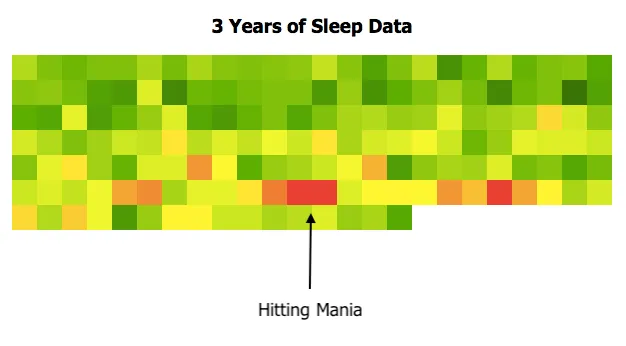
June 23, 2017 — I just pushed a project I've been working on called Ohayo.
You can also view it on GitHub: https://github.com/treenotation/ohayo
I wanted to try and make a fast, visual app for doing data science. I can't quite recommend it yet, but I think it might get there. If you are interested you can try it now.
June 21, 2017 — Eureka! I wanted to announce something small, but slightly novel, and potentially useful.
What did I discover? That there might be useful general purpose programming languages that don't use any visible syntax characters at all.
I call the whitespace-based notation Tree Notation and languages built on top of it Tree Languages.
Continue reading...A Suggestion for a Simple Notation
September 24, 2013 — What if instead of talking about Big Data, we talked about 12 Data, 13 Data, 14 Data, 15 Data, et cetera? The # refers to the number of zeroes we are dealing with.
You can then easily differentiate problems. Some companies are dealing with 12 Data, some companies are dealing with 15 Data. No company is yet dealing with 19 Data. Big Data starts at 12 Data, and maybe over time you could say Big Data starts at 13 Data, et cetera.
Continue reading...September 23, 2013 — Making websites is slow and frustrating.
Continue reading...April 2, 2013 — For me, the primary motivation for creating software is to save myself and other people time.
I want to spend less time doing monotonous tasks. Less time doing bureaucratic things. Less time dealing with unnecessary complexity. Less time doing chores.
I want to spend more time engaged with life.
Continue reading...Two people in the same forest, have the same amount of water and food, Are near each other, but may be out of sight, The paths behind each are equally long. The paths ahead, may vary. One's path is easy and clear. The other's is overgrown and treacherous. Their paths through the forest, in the past, in the present, and ahead are equal. Their journeys can be very different.
The crux of the matter, is that people don't understand the true nature of money. It is meant to circulate, not be wrapped up in a stocking @ Guglielmo Marconi
March 30, 2013 — I love Marconi's simple and clear view of money. Money came in and he put it to good use. Quickly. He poured money into the development of new wireless technology which had an unequal impact on the world.
This quote, by the way, is from "My Father, Marconi", a biography of the famous inventor and entrepreneur written by his daughter, Degna. Marconi's story is absolutely fascinating. If you like technology and entrepreneurship, I highly recommend the book.
P.S. This quote also applies well to most man made things. Cars, houses, bikes, et cetera, are more valuable circulating than idling. It seemed briefly we were on a trajectory toward overabundance, but the sharing economy is bringing circulation back.
March 30, 2013 — Why does it take 10,000 hours to become a master of something, and not 1,000 hours or 100,000 hours?
The answer is simple. Once you've spent 10,000 hours practicing something, no one can crush you like a bug.
Continue reading...March 16, 2013 — A kid says Mommy or Daddy or Jack or Jill hundreds of times before grasping the concept of a name.
Likewise, a programmer types name = Breck or age=15 hundreds of times before grasping the concept of a variable.
What do you call it when someone finally sees the concept?
John Calcote, a programmer with decades of experience, calls it a minor epiphany.
Continue reading...March 8, 2013 — If your software project is going to have a long life, it may benefit from Boosters. A Booster is something you design with two constraints: 1) it must help in the current environment 2) it must be easy to jettison in the next environment.

February 24, 2013 — It is a popular misconception that most startups need to fail. We expect 0% of planes to crash. Yet we switch subjects from planes to startups and then suddenly a 100% success rate is out of the question.
This is silly. Maybe as the decision makers switch from gambling financeers to engineers we will see the success rate of starting a company shoot closer to 100%.
February 16, 2013 — Some purchasing decisions are drastically better than others. You might spend $20 on a ticket to a conference where you meet your next employer and earn 1,000x "return" on your purchase. Or you might spend $20 on a fancy meal and have a nice night out.
Continue reading...February 12, 2013 — You shouldn't plan for the future. You should plan for one of many futures.
The world goes down many paths. We only get to observe one, but they all happen.
In the movie "Back to the Future II", the main character Marty, after traveling decades into the future, buys a sports alamanac so he can go back in time and make easy money betting on games. Marty's mistake was thought he had the guide to the future. He thought there was only one version of the future. In fact, there are many versions of the future. He only had the guide to one version.
Marty was like the kid who stole the answer key to an SAT but still failed. There are many versions of the test.
There are infinite futures. Prepare for them all!
December 29, 2012 — I love that phrase.
I want to learn how to program. Prove it.
I value honesty. Prove it.
I want to start my own company. Prove it.
It works with "we" too.
We're the best team in the league. Prove it.
We love open source. Prove it.
We're going to improve the transportation industry. Prove it.
Words don't prove anything about you. How you spend your time proves everything.
The only way to accurately describe yourself or your group is to look at how you've spent your time in the past. Anytime someone says something about what they will do or be like in the future, your response should be simple: prove it.
December 23, 2012 — If you are poor, your money could be safer under the mattress than in the bank:
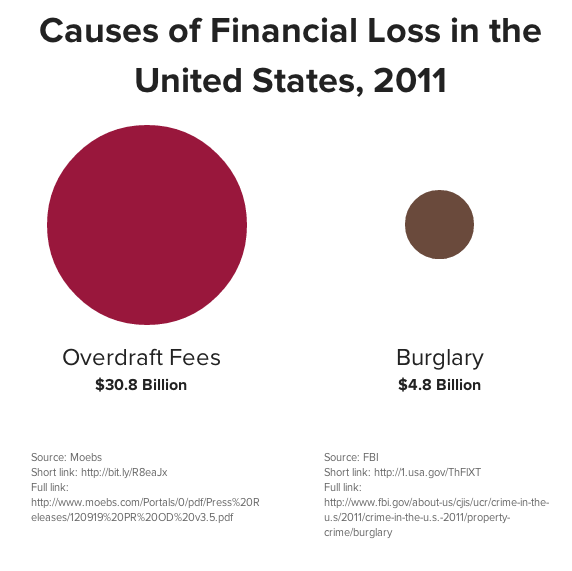
The Great Bank Robbery dwarfs all normal burglaries by almost 10x. In the Great Bank Robbery, the banks are slowly, silently, automatically taking from the poor.
One simple law could change this:
What if it were illegal for banks to automatically deduct money from someone's account?
If a bank wants to charge someone a fee, that's fine, just require they send that someone a bill first.
What would happen to the statistic above, if instead of silently and automatically taking money from people's accounts, banks had to work for it?
Sources
Moebs via wayback machine

December 22, 2012 — Entrepreneurship is taking responsibility for a problem you did not create.
It was not Google's fault that the web was a massive set of unorganized pages that were hard to search, but they claimed responsibility for the problem and solved it with their engine.
It was not Dropbox's fault that data loss was common and sharing files was a pain, but they claimed responsibility for the problem and solved it with their software.
It is not Tesla's fault that hundreds of millions of cars are burning gasoline and polluting our atmosphere, but they have claimed responsibility for the problem and are attempting to solve it with their electric cars.
Continue reading...December 19, 2012 — For the past year I've been raving about Node.js, so I cracked a huge smile when I saw this question on Quora:
In five years, which language is likely to be most prominent, Node.js, Python, or Ruby, and why? - QuoraContinue reading...
There's a man in the world who is never turned down, wherever he chances to stray; he gets the glad hand in the populous town, or out where the farmers make hay; he's greeted with pleasure on deserts of sand, and deep in the aisles of the woods; wherever he goes there's the welcoming hand--he's The Man Who Delivers the Goods. The failures of life sit around and complain; the gods haven't treated them white; they've lost their umbrellas whenever there's rain, and they haven't their lanterns at night; men tire of the failures who fill with their sighs the air of their own neighborhoods; there's one who is greeted with love-lighted eyes--he's The Man Who Delivers the Goods. One fellow is lazy, and watches the clock, and waits for the whistle to blow; and one has a hammer, with which he will knock, and one tells a story of woe; and one, if requested to travel a mile, will measure the perches and roods; but one does his stunt with a whistle or smile--he's The Man Who Delivers the Goods. One man is afraid that he'll labor too hard--the world isn't yearning for such; and one man is always alert, on his guard, lest he put in a minute too much; and one has a grouch or a temper that's bad, and one is a creature of moods; so it's hey for the joyous and rollicking lad--for the One Who Delivers the Goods! Walt Mason, his book (1916)Continue reading...
December 18, 2012 — One of Nassim Taleb's big recommendations for how to live in an uncertain world is to follow a barbell strategy: be extremely conservative about most decisions, but make some decisions that open you up to uncapped upside.
In other words, put 90% of your time into safe, conservative things but take some risks with the other 10%.
Continue reading...December 18, 2012 — My whole life I've been trying to understand how the world works. How do planes fly? How do computers compute? How does the economy coordinate?
Over time I realized that these questions are all different ways of asking the same thing: how do complex systems work?
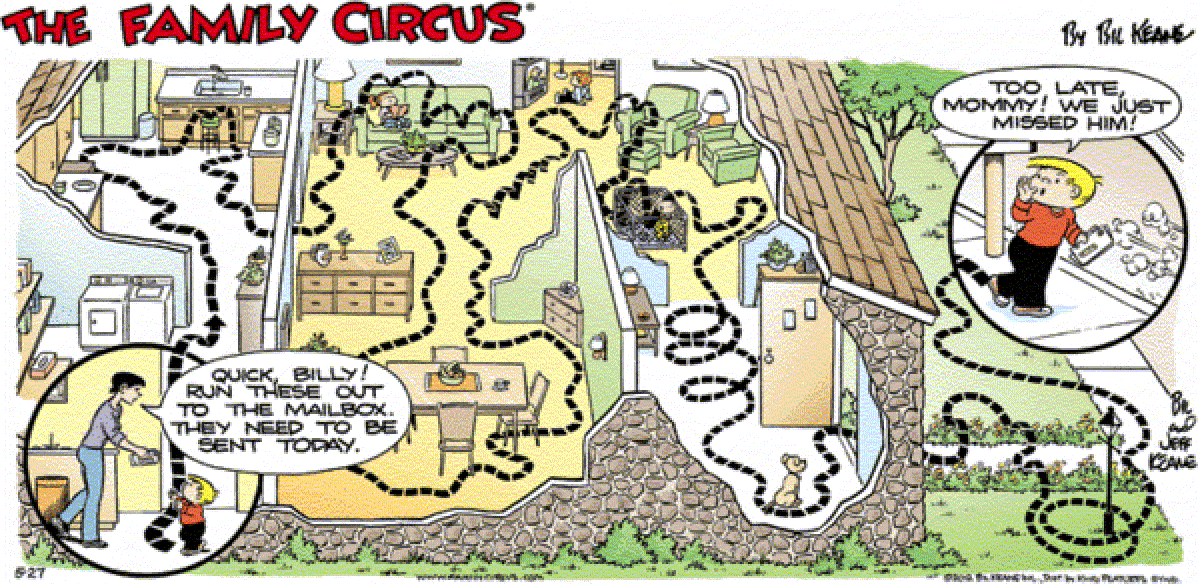
Continue reading...December 16, 2012 — When I was a kid I loved reading the Family Circus. My favorite strips were the "dotted lines" ones, which showed Billy's movements over time:
December 16, 2012 — Concise but not cryptic. e=mc² is precise and not too cryptic. Shell commands, such as chmod -R 755 some_dir are concise but very cryptic.
December 14, 2012 — Note is a structured, human readable, concise language for encoding data.
Continue reading...November 26, 2012 — For todo lists, I created a system I call planets and pebbles.
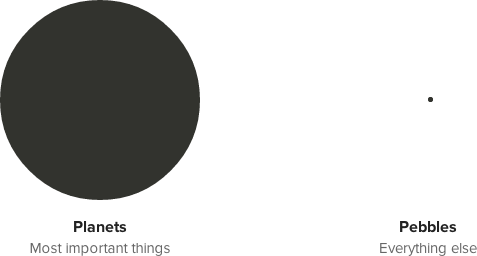
I label each task as a planet or a pebble. Planets are super important things. It could be helping a customer complete their project, meeting a new person, finishing an important new feature, closing a new sale, or helping a friend in need. I may have 20 pebbles that I fail to do, but completing one planet makes up for all that and more.
I let the pebbles build up, and I chip away at them in the off hours. But the bulk of my day I try to focus on the planets--the small number of things that can have exponential impact. I don't sweat the small stuff.
I highly recommend this system. We live in a power law world, and it's important to practice the skill of predicting what things will prove hugely important, and what things will turn out to be pebbles.
November 25, 2012 — I published 55 essays here the first year. The second and third years combined, that number nosedived to 5.
What caused me to stop publishing?
Continue reading...November 20, 2012 — "Is simplicity ever bad?" If you had asked me this a year ago, I probably would have called you a fucking moron for asking such a dumb question. "Never!", I would have shouted. Now, I think it's a fair question. Simplicity has it's limits. Simplicity is not enough, and if you pursue simplicity at all costs, that can be a bad thing. There's something more than simplicity that you need to be aware of. I'll get to that in a second, but first, I want to backtrack a bit and state clearly that I do strongly, strongly believe and strive for simplicity. Let me talk about why for a second.
Continue reading...October 20, 2012 — I love to name things.
I spend a lot of time naming ideas in my work. At work I write my code using a program called TextMate. TextMate is a great little program with a pleasant purple theme. I spend a lot of time using TextMate. For the past year I've been using TextMate to write a program that now consists of a few hundred files. There are thousands of words in this program. There are hundreds of objects and concepts and functions that each have a name. The names are super simple like "Pen" for an object that draws on the screen, and "delete" for a method that deletes something. Some of the things in our program are more important than others and those really important ones I've renamed dozens of times searching for the right fit.
Continue reading...March 30, 2011 — Railay is a tiny little beach town in Southern Thailand famous for its rock climbing. I've been in Railay for two weeks. When the weather is good, I'm outside rock climbing. When the weather is bad, I'm inside programming. So naturally I've found myself comparing the two. Specifically I've been thinking about what I can take away from my rock climbing experience and apply to my programming education.
Here's what I've come up with.
1. You should always be pushing yourself. Each day spent climbing I've made it to a slightly higher level than the previous day. The lazy part of me has then wanted to just spend one day enjoying this new level without pushing myself further. Luckily I've had a great climbing partner who's refused that and has forced me to reach for the next level each day. In both rock climbing and programming you should always be reaching for that new level. It's not easy, you have to risk a fall to reach a new height, but it's necessary if you want to become good. In programming, just like in climbing, you should be tagging along with the climbers at levels above you. That's how you get great. Of course, don't forget to enjoy the moment too.
Continue reading...March 5, 2011 — A good friend passed along some business advice to me a few months ago. "Look for a line," he said. Basically, if you see a line out the door at McDonald's, start Burger King. Lines are everywhere and are dead giveaways for good business ideas and good businesses.
Continue reading...March 4, 2011 — I haven't written in a long while because i'm currently on a long trip around the world. at the moment, we're in indonesia. one thing that really surprised me was that despite our best efforts to do as little planning as possible, we were in fact almost overprepared. i've realized you can do an around the world trip with literally zero planning and be perfectly fine. you can literally hop on a plane with nothing more than a passport, license, credit card, and the clothes on your back and worry about the rest later. i think a lot of people don't make a journey like this because they're intimidated not by the trip itself, but by the planning for the trip. i'm here to say you don't need to plan at all to travel the world (alas, would be a lot harder if you were not born in a first world country, unfortunately). here's my guide for anyone that might want to attempt to do so. every step is highlighted in bold. adjust accordingly for your specific needs and desires.
The plan (see below for bullet points)
Set a savings goal. you'll need money to travel around the world, and the more money you have, the easier, longer, and more fun your journey will be.
Continue reading...September 18, 2010 — I was an Economics major in college but in hindsight I don't like the way it was taught. I came away with an academic, unrealistic view of the economy. If I had to teach economics I would try to explain it in a more realistic, practical manner.
I think there are two big concepts that if you understand, you'll have a better grasp of the economy than most people.
Continue reading...August 25, 2010 — Warren Buffet claims to follow an investment strategy of staying within his "circle of competence". That's why he doesn't invest in high tech--it's outside his circle.
I think this is good advice. The tricky part is to figure out where to draw the circle.
Here are my initial thoughts:
- Start with a small circle. Be conservative about where you draw the circle.
- Do what you're good at as opposed to what you want to do. Our economy rewards specialization. You want to work on interesting problems, but it pays better to work on things you've done before. Use that money to explore the things you want to do.
- Be a big fish in a small circle.
- Spend time outside your circle, but expand it slowly. Definitely work hard to improve your skill set but don't overreach. It's better to have a solid core and build momentum from that than to be marginal in a lot of areas.
August 25, 2010 — I have a feeling critical thinking gets the least amount of brain's resources. The trick is to critically think about things, come to conclusions, and turn those conclusions into habits. The subconcious, habitual mind is much more powerful than the tiny little conscious, critically thinking mind.
If you're constantly using the critical thinking part of your mind, you're not using the bulk of your mind. You're probably accomplishing a lot less than you could be.
Come to conclusions and build good habits. Let your auto pilot take over. Then occasionally come back and revisit your conclusions.
August 25, 2010 — I've been working on a fun side project of categorizing things into Mediocristan or Extremistan(inspired by NNT's book The Black Swan).
I'm trying to figure out where intelligence belongs. Bill Gates is a million times richer than many people; was Einstein a million times smarter than a lot of people? It seems highly unlikely. But how much smarter was he? Was he 1,000x smarter than the average joe? 100x smarter?
I'm not sure. The brain is a complex thing and I haven't figure out how to think about intelligence yet.
Would love to hear what other people think. Shoot me an email!
August 25, 2010 — Maybe I'm getting old, but I'm starting to think the best way to "change the world" isn't to bust your ass building companies, inventing new machines, running for office, promoting ideas, etc., but to simply raise good kids. Even if you are a genius and can invent amazing things, by raising a few good kids their output combined can easily top yours. Nerdy version: you are a single core cpu and can't match the output of a multicore machine.
I'm not saying I want to have kids anytime soon. I'm just realizing after spending time with my family over on Cape Cod, that even my dad, who is a harder worker than anyone I've ever met and has made a profound impact with his work, can't compete with the output of 4 people (and their potential offspring), even if they each work only 1/3 as hard, which is probably around what we each do. It's simple math.
So the trick to making a difference is to sometimes slow down, spend time raising good kids, and delegate some of the world saving to them.
August 25, 2010 — Genetics, aka nature, plays the dominant role in predicting most aspects of your life, in my estimation.
Continue reading...August 25, 2010 — Doctors used to recommend leeches to cure a whole variety of illnesses. That seems laughable today. But I think our recommendations today will be laughable to people in the future.
Recommendations work terrible for everyone but decently on average.
Continue reading...August 25, 2010 — Ruby is an awesome language. I've come to the conclusion that I enjoy it more than Python for the simple reason that whitespace doesn't matter.
Python is a great language too, and I have more experience with it, and the whitespace thing is a silly gripe. But I've reached a peak with PHP and am looking to master something new. Ruby it is.
August 25, 2010 — I've been very surprised to discover how unpredictable the future is. As you try to predict farther out, your error margins grow exponentially bigger until you're "predicting" nothing specific at all.
Continue reading...August 23, 2010 — Your most recent experiences effect you the most. Reading this essay will effect you the most today but a week from now the effect will have largely worn off.
Continue reading...August 23, 2010 — Note: Sometimes I'll write a post about something I don't understand at all. I am not a neuroscientist and have only the faintest understanding of the brain so this is one of those times. Reading this post could make you dumber. But occasionally writing from ignorance leads to good things--like the time I wrote about Linear Algebra and got a number of helpful emails better explaining the subject to me.
My question is: how are the brain's resources allocated for its different tasks?
Continue reading...August 11, 2010 — I've had some free time the past two weeks to work on a few random ideas I've had.
They all largely involve probability/statistics and have no practical or monetary purpose. If I was a painter and not a programmer you might call them "art projects".
Continue reading...August 6, 2010 — Three unexpected things have happened to me during my two years of entrepreneurial pursuits in California.
First, I have not gotten rich.
Second, I have met many people who have gotten rich. I've even had the pleasure to witness some of my friends get rich.
Third, I've yet to meet someone much happier than me.
I've met a large amount of people who are 6, 7, even 8 orders of magnitude richer than me and yet not a single one of them was even close to an order of magnitude happier than me.
The explanation, I finally realized, is simple.
Continue reading...August 6, 2010 — In February I celebrated my 26th Orbit. I am 26 orbits old. How many orbits are you?
I think we should use the word "orbit" instead of year. It's less abstract. The earth's 584 million mile journey around the sun is an amazing phenomena, and calling it merely "another year" doesn't do it justice.
Continue reading...August 6, 2010 — Figuring out what you want in life is very hard. No one tells you exactly what you want. You have to figure it out on your own.
When you're young, it doesn't really matter what you want because your parents choose what you do. This is a good thing, otherwise kids would grow up uneducated and malnourished from ice cream breakfasts. But when you grow up, you get to call the shots.
Continue reading...August 3, 2010 — Last night over dinner we had an interesting conversation about why we care about celebrities. Here's my thinking on the matter.
Continue reading...July 2, 2010 — A year ago I wrote a post titled The Truth about Web Design where I briefly argued that "design doesn't matter a whole lot."
My argument was: "you go to a website for the utility of it. Design is far secondary. There are plenty of prettier things to look at in the real world."
I do think the real world is a pretty place, but about design, I was completely wrong.
Continue reading...June 28, 2010 — Competition and specialization are generally positive economics forces. What's interesting is that they are contradictory.
Continue reading...June 17, 2010 — Doing a startup is surprisingly simple. You have to start by creating a product that people must have, then you scale it from there.
What percent of your customers or "users" would be disappointed if your product disappeared tomorrow? If it's less than 40%, you haven't built a must have yet.
Continue reading...June 16, 2010 — Every Sunday night in college my fraternity would gather in the commons room for a "brother meeting". (Yes, I was in a fraternity, and yes I do regret that icing hadn't been invented yet). These meetings weren't really "productive", but we at least made a few decisions each week. The debates leading up to these decisions were quite fascinating. The questions would be retarded, like whether or not our next party should be "Pirate" themed or "Prisoner" themed(our fraternity was called Pike, so naturally(?) we were limited to themes that started with the letter P so we could call the party "Pike's of the Caribbean" or something). No matter what the issue, we would always have members make really passionate arguments for both sides.
Continue reading...June 15, 2010 — I think it's interesting to ponder the value of information over it's lifetime.
Different types of data become outdated at different rates. A street map is probably mostly relevant 10 years later, while a 10 year old weather forecast is much less valuable.
Phone numbers probably last about 5 years nowadays. Email addresses could end up lasting decades. News is often largely irrelevant after a day. For a coupon site I worked on, the average life of a coupon seemed to be about 2 weeks.
If your data has a long half life, then you have time to build it up. Wikipedia articles are still valuable years later.
What information holds value the longest? What are the "twinkies" of the data world?
Books, it seems. We don't regularly read old weather forecasts, census rolls, or newspapers, but we definitely still read great books, from Aristotle to Shakespeare to Mill.
Facts and numbers have a high churn rate, but stories and knowledge last a lot longer.
June 14, 2010 — Have you heard of the Emperor Penguins? It's a species of penguins that journeys 30-75 miles across the frigid Antarctic to breed. Each year these penguins endure 8 months of brutally cold winters far from food. If you aren't familiar with them, check out either of the documentaries March of the Penguins or Planet Earth.
I think the culture of the emperor penguins is fascinating and clearly reveals some general traits from all cultures:
Culture is a set of habits that living things repeat because that's what they experienced in the past, and the past was favorable to them. Cultures have a mutually dependent relationship with their adherents.Continue reading...
Or..We Think we have Free Will because we only Observe One Path.
March 24, 2010 — "Dad, I finished my homework. Why?"
The father thinks for a moment. He realizes the answer involves explaining the state of the world prior to the child doing the homework. It involves explaining the complex probabilities that combined would calculate the odds the child was going to do the homework. And it likely involved explaining quantum mechanics.
The father shrugs and says "Because you have free will, and chose to do it."
Continue reading...March 22, 2010 — Google has a list of 10 principles that guide its actions. Number 2 on this list is:
It's best to do one thing really, really well.
This advice is so often repeated that I thought it would be worthwhile to think hard about why this might be the case.
Continue reading...March 17, 2010 — If you automate a process which you repeat Y times, that takes X minutes, what would your payoff be?
Payoff = XY minutes saved, right?
Surprisingly I've found that is almost never the case. Instead, the benefits are almost always greater than XY. In some cases, much greater. The benefits of automating a process are greater than the sum of the process' parts.
Actual Payoff = XY minutes saved + E
What is E? It's the extra something you get from not having to waste time and energy on XY.
Continue reading...March 16, 2010 — I wrote a simple php program called phpcodestat that computes some simple statistics for any given directory.
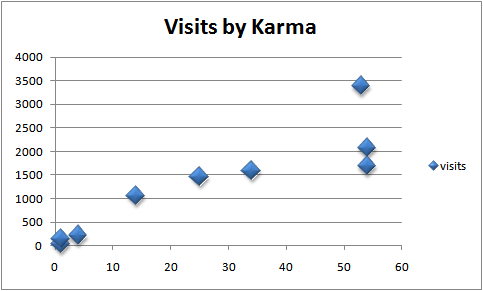
Continue reading...March 8, 2010 — If a post on HackerNews gets more points, it gets more visits.
But how much more? That's what Murkin wanted to know.
I've submitted over 10 articles from this site to HackerNews and I pulled the data from my top 5 posts (in terms of visits referred by HackerNews) from Google Analytics.
Here's how it looks if you plot visits by karma score:
February 19, 2010 — All the time I overhear people saying things like "I will start excercising everyday" or "We will ship this software by the end of the month" or "I will read that book" or "I will win this race." I'm guilty of talking like this too.
The problem is that often, you say you will do something and you don't end up doing it. Saying "I will do", might even be a synonym for "I won't do".
Continue reading...February 17, 2010 — If a book is worth reading, it's worth buying too.
If you're reading a book primarily to gain value from it(as opposed to reading it for pleasure) you should always buy it unless it's a bad book.
Continue reading...February 2, 2010 — My room was always messy. Usually because clothes were strewn everywhere On the floor, on the couch, anywhere there was a surface there was a pile of clothes. Dirty, clean, or mostly-clean scattered about.
Continue reading...January 29, 2010 — Good communication is overcommunication. Very few people overcommmunicate. Undercommunication is much more common. Undercommunication is also the cause of countless problems in business.
Instead of striving for some subjective "good communication", simply strive to overcommunicate. It's very unlikely you'll hit a point where people say "he communicates too much". It's much more likely you'll come up a bit short, in which case you'll be left with good communication.
Continue reading...January 22, 2010 — Network effects are to entrepreneurs what compounding effects are to investors: a key to getting rich.
Sometimes a product becomes more valuable simply as more people use it. This means the product has a "network effect".
Continue reading...January 15, 2010 — In computer programming, one of the most oft-repeated mottos is DRY: "Don't Repeat Yourself."
The downside of DRY's popularity is that programmers might start applying the principle to conversations with other humans.
This fails because computers and people are polar opposites.
With computers, you get zero benefit if you repeat yourself. With people, you get zero benefit if you don't repeat yourself!
Continue reading...January 14, 2010 — When a problem you are working on forces you to wait, do you wait or switch tasks?
For example, if you are uploading a bunch of new web pages and it's taking a minute, do you almost instinctively open a new website or instant message?
Continue reading...January 12, 2010 — Whether you're an entrepreneur, a venture capitalist, a casual investor or just a shopper looking for a deal, you should know how to buy low and sell high. Buying low and selling high is not easy. It's not easy because it requires too things humans are notoriously bad at: long term planning and emotional control. But if done over a long period of time, buying low and selling high is a surefire way to get rich.
Warren Buffett is perhaps the king of buying low and selling high. These tips are largely regurgitated from his speeches and biographies which I've been reading over the past two years.
Continue reading...January 5, 2010 — Possibly the biggest mistake a web startup can make is to develop in a bubble. This is based on my own experience launching 13 different websites over the past 4 years. The raw numbers:
| Type | Count | Successes | TimeToLaunch | CumulativeGrossRevenues | %ofTotalTraffic | CumulativeProfits | EmotionalToll |
|---|---|---|---|---|---|---|---|
| Bubble | 3 | 0 | Months | <$5,000 | <1% | -$10,000's | High |
| NonBubble | 10 | 5-8 | 1-14Days | $100,000's | >99% | Good | None-low |
What is "the bubble"?
The bubble is the early, early product development stage. When new people aren't constantly using and falling in love with your product, you're in the bubble. You want to get out of here as fast as possible.
Continue reading...December 28, 2009 — At our startup, we've practiced a diversification strategy.
We've basically run an idea lab, where we've built around 7 different products. Now we're getting ready to double down on one of these ideas.
Continue reading...2021 Update: I think the model and advice presented here is weak and that this post is not worth reading. I keep it up for the log, and not for the advice and analysis provided.
December 24, 2009 — Over the past 6 months, our startup has taken two approaches to diversification. We initially tried no diversification and then we tried heavy diversification.
In brief, my advice is:
Diversify heavily early. Then focus.Continue reading...
December 23, 2009 — It is better to set small, meaningful goals than to set wild, audacious goals.
Here's one way to set goals:
Make them good. Make them small.Continue reading...
December 20, 2009 — Programming, ultimately, is about solving problems. Often I make the mistake of judging a programmer's work by the elegance of the code. Although the solution is important, what's even more important is the problem being solved.
Problems are not all created equal, so while programming you should occasionally ask yourself, "is this problem worth solving?"
Continue reading...December 16, 2009 — If you combine Paul Graham's "make something people want" advice with Sean Ellis' product-market fit advice (you have product-market fit when you survey your users and at least 40% of them would be disappointed if your product disappeared tomorrow), you end up with a possibly even simpler, more specific piece of advice:
Make something 40% of your users must haveContinue reading...
December 15, 2009 — The best Search Engine Optimization(SEO) system I've come across comes from Dennis Goedegebuure, SEO manager at eBay. Dennis' system is called LUMPS. It makes SEO dead simple.
Just remember LUMPS:
- Links
- Uurls
- Metadata
- Page Content
- Sitemaps
December 13, 2009 — Do you "flip the bozo bit" on people?
If you don't know what that means, you probably do it unknowingly!
Continue reading...December 11, 2009 — Jason Fried from 37signals gave a great talk at startup school last month. At one point he said "software has no edges." He took a normal, everyday bottle of water and pointed out 3 features:
- 1. The bottle held the water.
- 2. The lightweight plastic made it easy to carry, and you can tell how full it was by picking it up.
- 3. The clear bottle let you see how much was left and what was in it.
If you added a funnel to help pour the water, that might be useful in 5% of cases, but it would look a little funny. Then imagine you attach a paper towel to each funnel for when you spill. Your simple water bottle is now a monstrosity.
The clear edges of physical products make it much harder for feature creep to happen. But in software feature creep happens, and happens a lot.
Continue reading...December 10, 2009 — Employees and students receive deadlines, due dates, goals, guidelines, instructions and milestones from their bosses and teachers. I call these "arbitrary constraints".
Does it really matter if you learn about the American Revolution by Friday? No. Is there a good reason why you must increase your sales this month by 10%, versus say 5% or 15%? No. Does it really matter if you get a 4.0 GPA? No.
But these constraints are valuable, despite the fact that they are arbitrary. They help you get things done.
Continue reading...December 9, 2009 — A lot of people have the idea that maybe one day they'll become rich and famous and then write a book about it. That's probably because it seems like the first thing people do after becoming rich and famous is write a book about it.
But you don't have to wait until you're rich and famous to write a book about your experiences and ideas.
Continue reading...December 8, 2009 — Finding experienced mentors and peers might be the most important thing you can do if you want to become a great programmer. They will tell you what books to read, explain the pros and cons of different languages, demystify anything that seems to you like "magic", help you when you get in a jam, work alongside you to produce great things people want, and challenge you to reach new heights.
Continue reading...December 7, 2009 — Do you think in Orders of Magnitude? You should.
If you think in orders of magnitude you can quickly visualize how big a number is and how much effort it would take to reach it.
Continue reading...December 6, 2009 — Imagine you are eating dinner with 9 friends and you all agree to play Credit Card Roulette. Credit Card Roulette is a game where everyone puts their credit card in a pile and the server randomly chooses one and charges the whole meal to it.
Continue reading...December 4, 2009 — Do you want to become a great coder? Do you have a passion for computers but not a thorough understanding of them? If so, this post is for you.
Continue reading...December 3, 2009 — What would happen if instead of writing about subjects you understood, you wrote about subjects you didn't understand? Let's find out!
Today's topic is linear algebra. I know almost nothing about vectors, matrices, and linear algebra.
Continue reading...December 2, 2009 — What books have changed your life? Seriously, pause for a few minutes and think about the question. I'll share my list in a moment, but first come up with yours.
Continue reading...Experience is what you get when you don't get what you want.
December 2, 2009 — How many times have you struggled towards a goal only to come up short? How many times have bad things happened to you that you wish hadn't happened? If you're like me, the answer to both of those is: a lot.
Continue reading...December 2, 2009 — Decided to blog again. I missed it. Writing publicly, even when you only get 3 readers, two of which are bots and the other is your relative, is to the mind what exercise is to the body. It's fun and feels good; especially when you haven't done it in a while.
Continue reading...May 6, 2009 — There’s a discussion on a mailing list I belong to about piracy and the iPhone. One of the responders I thought was really insightful. The basic premise is “what you focus on, increases”–at least in your mind–so it’s better not to focus on negative things. In this example, by focusing on the small problem of pirated iPhone apps, bigger opportunities are missed. I’ve reprinted the part below:
Continue reading...April 14, 2009 — Here’s what I’m going to assume: craigslist, Google, and eBay do not have very pretty designs. How can a website be so successful if the design isn’t pretty? My position is that because design doesn’t matter a whole lot.
Continue reading...April 6, 2009 — Twitter Search is starting to replace a ton of websites that I used to visit.
Continue reading...March 31, 2009 — There’s a post currently on Hacker News that discusses irrational numbers. A long time ago irrational numbers really bothered me. I remember I had a teacher in high school who gave us extra credit for reading books about math that dealt with specific topics like pi or irrational numbers. These books gave me nightmares :). I still don’t really understand irrational numbers but haven’t thought about them in a long time. According to Wikipedia:
Continue reading...January 5, 2009 — I’m reading a fascinating biography of Warren Buffett right now(Snowball).
Continue reading...November 23, 2008 — A bright meteorite was caught on film in Canada this week.
I think with the recent exponential growth in video cameras we’ll all become a lot more familiar with meteorites in the years ahead.
Continue reading...October 12, 2008 — I just want to share the most valuable piece of Internet startup advice I possess.
The startup advice out there is filled with pyschology mumbo jumbo, but ALL THAT REALLY MATTERS IS THE NUMBERS.
Continue reading...September 19, 2008 — Got in to San Fran last night. Moved in to the Mission District with college buddies. I expect to be a multibillionaire in a month, tops.
Continue reading...August 20, 2008 — This evening JustHackIt.com launched. Before you co-found a company, you need to find good co-founders. The best way to do that is to just work on projects with people. The idea for JustHackIt is to connect hackers in one place and encourage them to just start projects together, without even knowing the person. Hopefully you’ll find some people who are smart, talented, and will make a great co-founder in the future.
Continue reading...July 28, 2008 — On August 31, 1854, a Londoner living on Broad Street fell ill with cholera and died. In three days, 127 other Londoners would also contract and die of cholera. By September 10th, over 500 people had died and panic was setting in on the London streets. Doctors studied the dead but could not solve the epidemic.
Continue reading...July 28, 2008 — The hiccups have been cured. Want to know what the secret is?
It’s simple, whenever you get the hiccups, all you have to do is think to yourself “I am not a fish. I am not a fish. I am not a fish…”
Continue reading...July 27, 2008 — Decided to try out one of these book social networks to see if I can find some important books I should be reading. The idea is you enter the books you’ve read and rate them, as well as the books you want to read. Then the site will show you people who like similar books and you can hopefully stumble upon some books that they’ve read that you will like.
Continue reading...July 9, 2008 — It’s nice to know that more than 50% of the people alive today have been around for longer than I have(at least for a few more years).
Continue reading...July 7, 2008 — After months of deliberation, I’ve decided to quit my day job and work on my blog full time.
Well not really. But I thought that would serve as a nice segue into listing these bloggers who started making enough money to say that (and mean it):
Continue reading...May 14, 2008 — The other day I wrote a post on How much Gas Americans use per day. The answer is 400 Million Gallons. A reader wanted to know how much gas the whole world consumes in a day. The answer is about 83 millon bbl’s. One bbl = 42 gallons, so the world consumes about 3.5 billion gallons of gas per day. That means the United States consumes 11% of the total gas consumed per day.
Continue reading...May 8, 2008 — xirium posted a tarball of all the individual profile pages for HackerNews readers(minus lurkers and those who joined after 05/07/2008). I was curious what insights, if any, could be gleamed from analyzing the data. My findings are below. I could have figured out more interesting things if I also included posts in my data, but I was looking for something simple to work on. BTW, to get the data into a table I wrote a simple python script to parse the html files. The source code is at the bottom. Or you can download the resulting dataset as an excel file.
Continue reading...September 28, 2007 — So after 1 year, my Fantasy Stock Portfolio returned a little over 150%, which was enough to capture 1st place. We used the MarketWatch game. At first I had no competition among our friends in our private game, although Conor(and his risky day trading in the subprime market) spiked at one point and finished around 80%. I lucked out thanks to a hot tech market and picking some of the best companies in that. Not a single pick lost money(though this is lucky).
Continue reading...September 13, 2007 — Every successful person in the startup world will tell you that the most important part of any startup is the team. From my own experiences, I wholeheartedly agree. But everyday I talk to people who think the most important thing is the idea. For instance, I just met a nice young woman at Logan Airport. She was wearing a well-pressed white blouse and grey skirt, dressed to impressed for her job at a prominent Boston-based health care consulting firm. We started talking about Facebook, and she repeated something I’ve heard at least a dozen times “[Zuckerberg] is going to make so much money. Facebook was such a simple idea. I wish I had thought of that.” I smiled and agreed pleasantly while trying hard not to roll my eyes.
Continue reading...while ($brecks_programming_skills < ‘great’) { write_learning_how_to_program_series(); }
August 28, 2007 — I thought today I’d write my first post on programming. I have always been very passionate about computers, but to be honest my programming skills are embarrassingly weak. Mainly it’s because I haven’t spent any time developing them. Although I wrote my first webpage in 1996, it wasn’t until 2002 at Duke that I wrote my first computer program.
Continue reading...August 24, 2007 — For a few years, GoDaddy kept alerting me that BreckYunits.com was available and I should buy fast before someone else does! Lucky for me, all the other Breck Yunits’ out there weren’t getting the same alerts. Enjoy BreckYunits.info, suckers!!!
Continue reading...